What Form 5564 actually does — three things at once
Form 5564 is short — often a single page — which makes it easy to underestimate. Signing and returning it does three distinct things simultaneously:
- It authorizes immediate assessment. Instead of the IRS waiting out your 90-day window (or your Tax Court case, if you'd filed one), the tax becomes formally assessed as soon as the IRS processes your signed form.
- It waives your Tax Court petition right for that specific deficiency. Once signed, you can no longer petition the Tax Court over this proposed amount — that door closes the moment the IRS receives the form, not on the 90th day.
- It waives your right to a separate notice of claim disallowance — and starts a 2-year clock. This is the detail almost every consumer guide skips. The form's own printed consent language cites the specific statute: you waive the requirement under IRC § 6532(a)(1) that a notice of claim disallowance be sent to you by certified mail for any overpayment shown on the attached report. Signing doesn't just waive that notice — per the form's own text, it starts the 2-year period for filing a refund suit running immediately, as if that certified notice had actually been sent. If you don't act within that 2 years, you can lose the ability to sue for a refund even on amounts you were legitimately owed.
What "irrevocable" actually forecloses, precisely: the form's own printed instructions state that after signing, if you later file a claim and the IRS disallows it, your only path is a refund suit in U.S. District Court or the U.S. Court of Federal Claims — you may not file a petition with the U.S. Tax Court at that point. Your consent doesn't prevent you from filing a refund claim later if you genuinely believe you're entitled to one (after paying the tax), and it doesn't stop the IRS from later determining you owe additional tax if that turns out to be the case. But the forum for any future dispute over this liability has permanently changed.
Romeo Razi — Former IRS Auditor
"People treat this like a receipt — sign here, acknowledge you got the notice. It's not that. It's a legal waiver of specific rights, and the IRS treats it as final the moment it's in their system. I've seen taxpayers sign this the same day the CP3219A arrived, just to 'get it over with,' without ever checking whether the number was even right."
What Form 5564 actually looks like
Since the IRS doesn't publish a blank version of this form (see the FAQ below), here's a real example — with all identifying taxpayer information removed — so you know what to expect when yours arrives attached to a CP3219A. This particular example is a 1992 revision; current notices use updated formatting, but the legal substance below is unchanged.
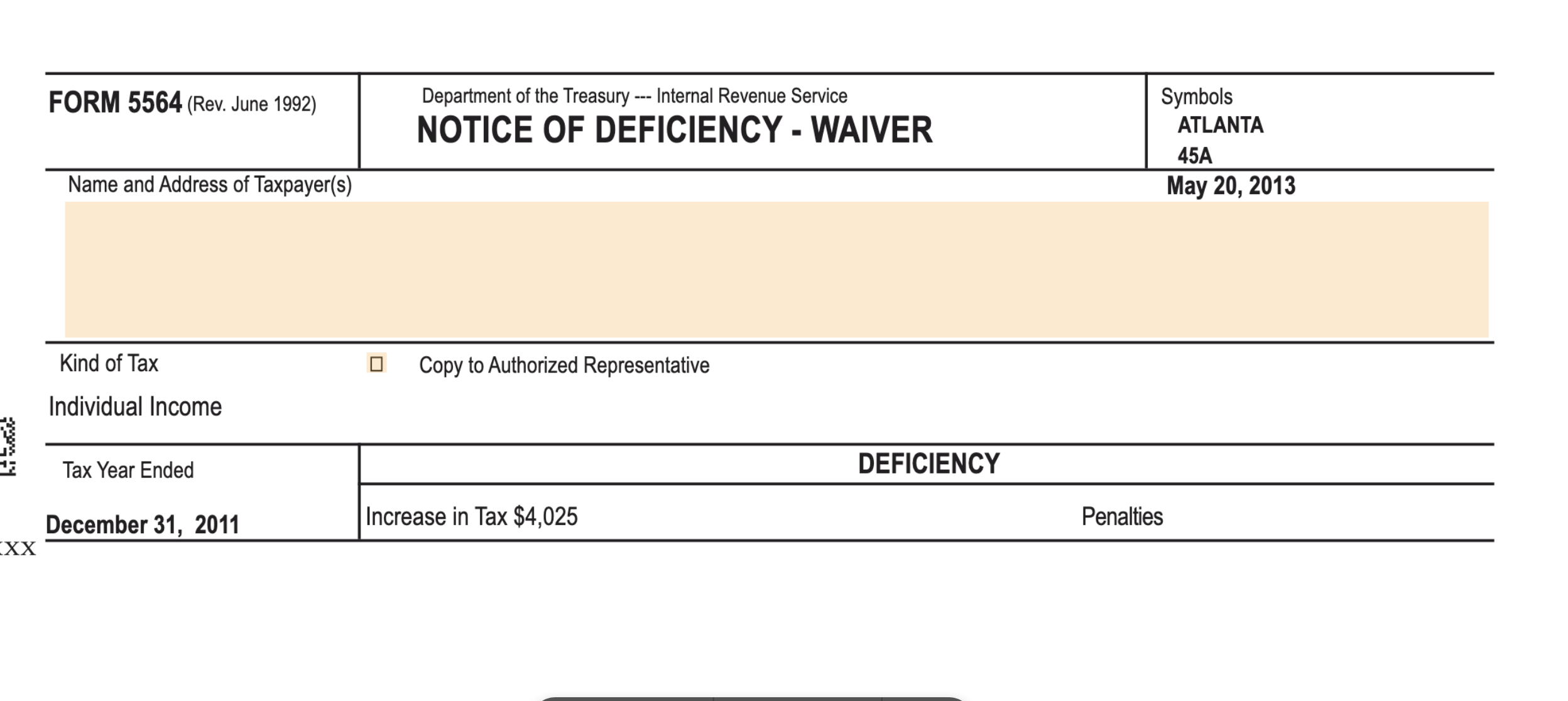
The top section identifies the IRS service center handling your case ("Symbols"), the tax year at issue, and the proposed deficiency — the additional tax the IRS believes you owe, separate from any penalties.
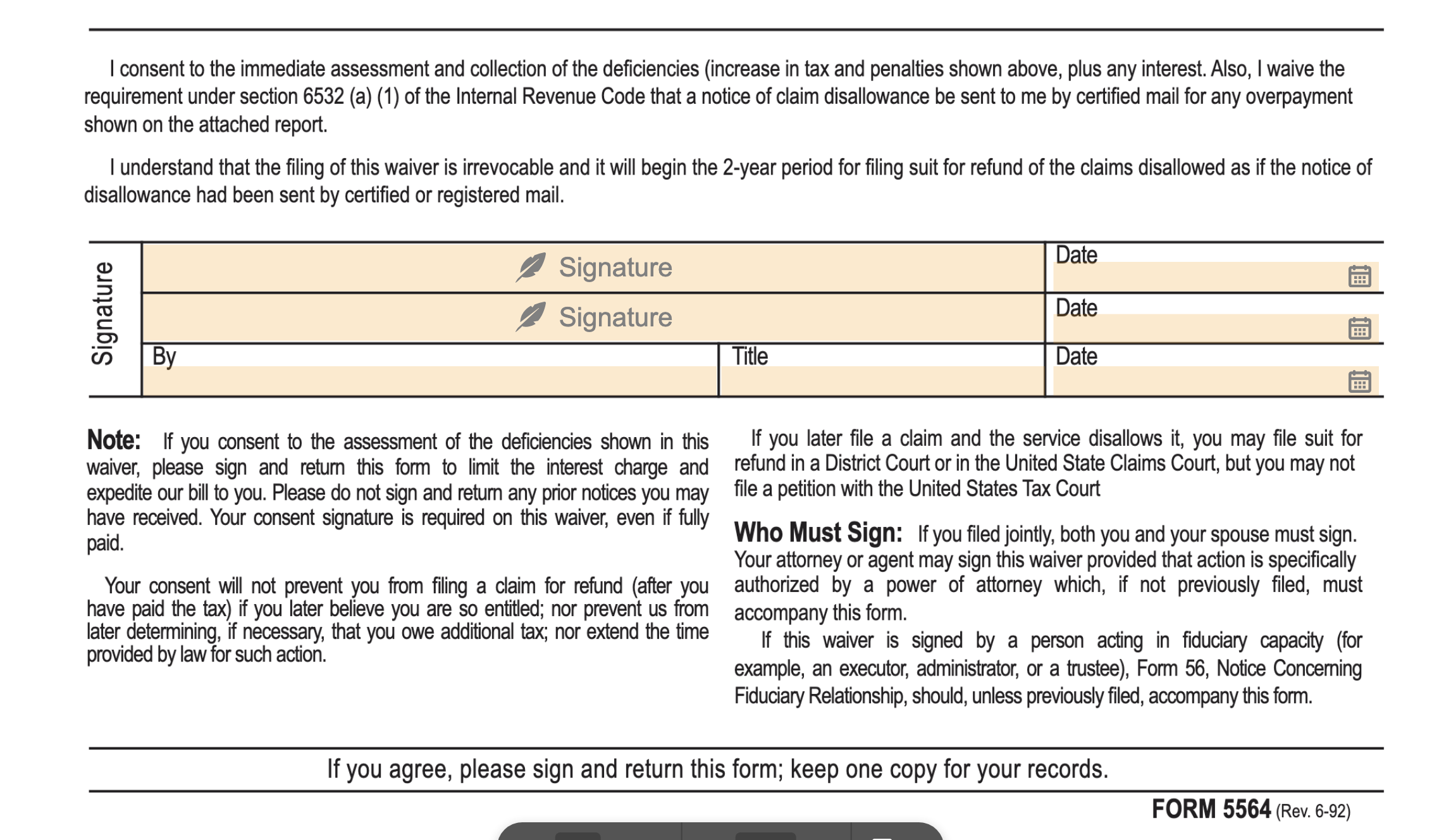
The bottom section is the actual legal text you're agreeing to by signing — the consent to immediate assessment, the IRC § 6532(a)(1) waiver, and the "Who Must Sign" instructions covering joint filers, powers of attorney, and fiduciaries.
Why "irrevocable" is taken so seriously — and what actually changes it
Every source that discusses Form 5564 — including the form's own printed language — states plainly that the waiver is irrevocable once signed and returned. That's not marketing language from a tax relief company; it's the form's own legal text, and the Tax Court and IRS both treat it as a closed matter absent extraordinary circumstances.
This mirrors a broader, well-established principle in tax administration: agreements and waivers that finalize a tax matter — closing agreements, Form 870 waivers, and Form 5564 among them — are given strong finality by both the IRS and the courts specifically so that cases can actually close. Courts have historically been very reluctant to unwind a signed waiver of this kind, generally reserving that possibility only for cases involving fraud, mutual mistake of a fundamental fact, or misrepresentation by the IRS — not simple buyer's remorse after the numbers turn out worse than expected.
The one place the IRS's own guidance acknowledges the numbers can look "wrong" without being an error
Here's a detail buried in the IRS's own CP3219A guidance that almost no third-party page repeats: the amount on your Form 5564 may not match the total shown elsewhere on your CP3219A — and that's expected, not a mistake. Not every adjustment on a CP3219A is something the Tax Court actually has jurisdiction to hear. The Form 5564 total reflects only the portion that's Tax-Court-eligible, which can be a different (often smaller) number than your notice's headline figure. Don't assume a discrepancy is a typo — read both documents item by item before deciding.
⚠ This same 90-day statutory window is the subject of active circuit-court litigation right now — see our full CP3219A guide for the current circuit split on whether the deadline itself can ever be extended. That uncertainty is about the deadline to petition Tax Court; it has no bearing on Form 5564's irrevocability once you've actually signed it.
Form 8626 — the rescission option almost no one mentions
If you believe the entire Notice of Deficiency shouldn't have been issued — not just that you disagree with the amount, but that new information means the IRS's own proposal is off-base — there's a third path beyond "sign Form 5564" or "petition Tax Court": Form 8626, Agreement to Rescind Notice of Deficiency.
This is a mutual agreement, not a unilateral taxpayer right. Both you and the IRS have to agree to rescind the notice, typically because new information has come to light or because more time is genuinely needed to work through the numbers together — often during an active, good-faith negotiation with the examiner or Appeals. It must be requested within the same 90-day (150-day abroad) window as the original notice.
Why this matters: if the notice is genuinely rescinded, it's as though it was never issued — which can reset the clock for the IRS to eventually issue a corrected notice with accurate numbers, rather than forcing you into a Tax Court petition over figures everyone increasingly agrees are wrong. This only works with IRS cooperation, so it's most realistic when you already have an examiner or Appeals officer actively engaged with your case, not as a first move on a notice that just arrived.
How to actually fill out Form 5564
- Verify every identifying detail first. Name, address, Social Security number, and tax year must match your notice exactly. Errors here can delay processing.
- Confirm the dollar amount against your own math — not just against the CP3219A's headline number, but against your own recalculation of what you believe you actually owe, item by item.
- Both spouses sign if the original return was joint. A single signature on a jointly-filed year is commonly treated as an incomplete waiver. An attorney or authorized agent can sign on your behalf instead, but only if a Form 2848 (Power of Attorney) specifically authorizing that is already on file or accompanies the form. If you're signing in a fiduciary capacity — as an executor, administrator, or trustee — attach Form 56 (Notice Concerning Fiduciary Relationship) unless it's already been filed.
- Decide on payment before you mail it. You can submit Form 5564 alone, or with a full or partial payment — a partial payment means the IRS will bill you for the remainder afterward. If you already know you can't pay in full, include Form 9465 (Installment Agreement Request) with your response to request a payment plan at the same time, rather than waiting for a bill and applying separately. Sign and return the form even if you're paying in full at the same time — the consent signature is still required regardless of payment status, per the form's own printed instructions.
- Make sure you're signing the current notice, not an old one. If you received an earlier notice on the same matter (like a CP2000), don't sign and return that — only the current Form 5564 attached to your CP3219A is the one that matters.
- Choose your response channel — you have three. The IRS's Document Upload Tool is the fastest: upload a photo or scan using the access code printed on your specific notice. Fax and mail remain available too, each to the number or address printed on your notice — not a generic one found online. If mailing, send certified with return receipt.
- Keep a complete copy of the signed form, the CP3219A itself, and your mailing receipt for your own records indefinitely.
Reference: IRS fax numbers by service center — always use the specific number on your own notice first; this is a cross-check, not a replacement for it.
| Andover, MA | 877-477-9485 |
| Atlanta, GA | 877-477-0967 |
| Austin, TX | 877-477-0583 |
| Holtsville, NY | 877-477-9599 |
| Fresno, CA | 877-477-0962 |
| Ogden, UT | 877-477-9640 |
| Philadelphia, PA | 877-477-9602 |
If you're sending payment with your signed form, the payment mailing address can differ from where you send the form itself, and depends on which office issued your notice: Austin, TX notices go to the Austin service center directly; Andover, Atlanta, and Philadelphia notices go to Kansas City, MO; Fresno notices go to a specific Fresno P.O. box; Ogden notices go to Ogden; Holtsville notices go to a Cincinnati, OH P.O. box. Use the payment address on your notice or payment voucher rather than assuming it matches the reply address — they're often not the same.
⚠ Interest on the deficiency accrues from the original due date of the return (generally April 15 of the filing year) — not from the date of the CP3219A or the date you sign Form 5564. Signing quickly stops the running total from growing further, but it doesn't erase interest that's already accrued since the original due date.
Sources, and how this guide was researched
This guide was written by Romeo Razi, CPA — who spent 8+ years at the IRS as a Tax Examiner in the Individual & Employment Tax Division, handling these exact situations from the government's side, before representing taxpayers in 15+ years of private practice (10,000+ returns).
- IRS: Understanding your CP3219A notice — the IRS's only official page discussing Form 5564; source for the amount-mismatch nuance, the three response channels, fax numbers, payment addresses, the Form 1040-X combo scenario, and the identity-theft path. Page last reviewed by the IRS July 20, 2026.
- IRS: About Form 5564
- U.S. Tax Court — the alternative to signing Form 5564
- IRC § 6213 — the statutory basis for the 90-day deficiency window this form operates inside
- IRC § 6532(a)(1) — the specific notice-of-claim-disallowance requirement Form 5564 waives, and the source of the 2-year refund-suit clock
- Our CP3219A guide — full detail on the notice this form accompanies, including the current circuit split on deadline tolling
Every claim above was checked against these primary sources at the time of the last update — not against secondary coverage. Tax rules and forms can change; confirm current guidance at the linked source (or ask us directly) before acting.
Frequently asked questions about Form 5564
Can I revoke Form 5564 after I sign and mail it?
No. The form itself states the waiver is irrevocable, and the IRS treats it that way once received. Review your CP3219A and the proposed amount fully before signing — the 90-day window exists specifically so you have time to do that. If you're not sure, don't sign; petitioning Tax Court preserves your options in a way signing does not.
Why doesn't the amount on Form 5564 match the total on my CP3219A?
The IRS's own CP3219A guidance confirms this is normal: not every item on your notice can actually be challenged in Tax Court, so the Form 5564 amount reflects only the Tax-Court-eligible portion, which can differ from the notice's full total. Read both documents carefully rather than assuming a typo.
Do both spouses need to sign Form 5564 on a joint return?
Yes. If the original return was filed jointly, both spouses must sign and date Form 5564 for the waiver to be valid. A single signature on a joint-filed year's notice is generally treated as incomplete. The exception is if an attorney or agent signs on your behalf under a Form 2848 (Power of Attorney) specifically authorizing that, or if someone signs in a fiduciary capacity — as an executor, administrator, or trustee — in which case Form 56 (Notice Concerning Fiduciary Relationship) should accompany the form unless already on file.
What is Form 8626 and how is it different from Form 5564?
Form 8626 is an Agreement to Rescind Notice of Deficiency — a mutual agreement between you and the IRS to withdraw the deficiency notice entirely, generally used when new information surfaces or the IRS agrees more time is needed to work out the numbers. Unlike Form 5564, it requires the IRS's consent — you cannot force a rescission unilaterally — and it must be requested within the same 90-day (150-day abroad) window.
Can I sign Form 5564 for only part of the proposed deficiency?
Generally no — Form 5564 is built for full agreement with the proposed amount. If you agree with some adjustments but dispute others, the safer path is to petition Tax Court for the year (preserving your rights on the disputed items) while separately telling the IRS which specific adjustments you don't contest, rather than trying to partially sign the waiver.
Where do I send Form 5564?
There is no single universal mailing address, and mail isn't your only option. The IRS offers three response channels: its Document Upload Tool (fastest — upload a photo or scan using the access code on your notice), fax (to the number printed on your notice), or mail (to the address printed on your notice). All three are notice-specific, not generic IRS addresses or fax numbers you'd find by searching online — using the wrong one risks delay or misrouting during a window where timing genuinely matters.
Are there separate instructions for Form 5564?
Not really. Form 5564 is a short, often single-page form, and the IRS doesn't publish a lengthy separate instructions document the way it does for complex forms like the 1040. The "instructions" are effectively the CP3219A notice it arrives with, plus the explanation printed on the form itself — verify your identifying details, confirm the dollar amount, and both spouses sign if the original return was joint.
Can I submit Form 5564 online?
Yes, actually — correcting something worth getting right: the IRS's Document Upload Tool lets you submit your signed Form 5564 digitally, as a photo or scan (JPG, PNG, or PDF). It's the fastest of the three response channels the IRS offers. You'll need the access code printed on your specific CP3219A notice to use it — it's unique to your case, not a universal code. Mail and fax remain available as the other two options; there's no separate e-file system, but the upload tool is a genuine online path.
Is there a blank Form 5564 PDF I can download?
No, and this trips people up. Unlike a generic IRS form you print and fill in yourself, Form 5564 isn't published as a blank downloadable template — it only exists pre-filled with your specific case details (name, notice number, tax year, proposed deficiency amount), generated and mailed to you as part of your CP3219A package. If you want to see what one actually looks like before yours arrives, see the redacted example further up this page.
I agree with the CP3219A, but I also have other income, credits, or expenses to report. What do I do?
File Form 1040-X (Amended U.S. Individual Income Tax Return) to report those additional items, write "CP3219A" at the top of it, and submit it together with your signed Form 5564 through the same response channel. Signing Form 5564 alone only addresses the proposed deficiency — it doesn't give you a way to claim additional items you're separately entitled to. The 1040-X is how you do that in the same response.
What if my CP3219A is wrong because someone stole my identity?
Respond with a completed Form 14039, Identity Theft Affidavit, instead of treating this as a normal disagreement over the numbers. Include it with your reply through whichever response channel you're using. This is a distinct path from disputing the dollar amount — you're telling the IRS the underlying income or information isn't yours at all, which is a different claim than "the math is wrong."
 By Romeo Razi, CPA — Former IRS Tax Examiner
·Updated September 15, 2026
·Fact-checked against IRS primary sources
By Romeo Razi, CPA — Former IRS Tax Examiner
·Updated September 15, 2026
·Fact-checked against IRS primary sources